Pages

Showing posts with label Indian Defence News. Show all posts

Wednesday, 9 January 2013

India Cuts its Defense Budget

Big shock for a military trying to catch up with the Chinese
The Indian Finance Ministry appears to have put a stop to the headlong dash by the country's military to enlarge its defense forces to meet the China challenge, slashing the military budget by US$2 billion this year.

The cuts are necessary, officials say, because of economic distress and a ballooning fiscal deficit of 5.8 percent, up from 4.1 percent in 2011. But the fiscal adjustment, which has raised eyebrows, might not only have an impact on the country's defense preparedness but also throw off kilter vital acquisition projects of aircraft, choppers, howitzers and missiles.

The cut, for instance, appears likely to affect the already much-delayed $20-billion MMRCA (medium multi-role combat aircraft) project to acquire 126 French Rafale fighter jets, ministry sources sway.

India began a massive military buildup in 2010 after a November, 2008 attack by Pakistani militants on luxury hotels and other facilities in Mumbai that took 166 lives, and after an admission by military officials that they were unable to retaliate with a full-scale attack against Pakistan because they didn't have the military readiness to do so.

"New Delhi is in the throes of finalizing important contract negotiations to bolster segments like the artillery, aviation, air defense, night-fighting, anti-tank guided missiles and specialized tank and rifle ammunition. All these will now be pushed to the back burner," a source told Asia Sentinel.

The Army too, had sought a 30 per cent budget hike allocation for the 12th Plan (2012-17) including upgrading its rapid reaction ground force capability against China by building two specialized divisions in high-altitude areas at a cost estimated at more than US$11 billion. This plan too, will now have to wait.

What has most surprised policy watchers is that the current squeeze comes in the wake of Defense Minister AK Antony's campaign for an additional outlay of US$8.18 billion for 2013 due to "new ground realities" and the "changing security scenario" against the backdrop of a disquieting China-Pakistan collusion.

However, Antony has hinted that given the grim economic situation, his Ministry would be hard pressed to get the allocated money. "I am struggling to get the budgetary amount," he acknowledged on being probed about additional funds for the modernization of the three services.

Unfortunately, the defense's belt tightening coincides with a corresponding rise in India's security challenges. Already, the country's defense outlay of $35.09 billion seems paltry against China's official outlay of $106.41 billion. (Beijing's actual military spending is suspected to be twice as much). It is also an open secret that the Chinese are topping up their war supplies with strategic missiles, space-based assets, aircraft carriers, fighter jets, warships and more.

With India's GDP growth plummeting to between 5 to 6 percent (from 9 percent in 2009), there may be more forced thrift in the offing, reveal sources. With elections for the lower house (Lok Sabha) in 2014, and no less than 10 states going to polls this year, the ruling UPA (United Progressive Alliance) will also be under pressure to invest funds in populist measures rather than defense procurement.

"The defense squeeze at this juncture will also disappoint the global defense industry which has been salivating at the thought of snapping up lucrative defense contracts from the Indian government," said Abhijeet Deodhar, a foreign policy analyst. Delhi last year, he said, earmarked an estimated US $80 billion for military modernization over the next three years. The cut, he adds, will hit the global players hard as they are already facing shrinking business prospects from western economies caught in an economic slowdown.

The squeeze notwithstanding, India's defense establishment could surely do with some fund infusion. In a letter from army Chief V.K. Singh to Prime Minister Manmohan Singh last year that was leaked to the Indian press, Singh described in detail the sorry state of affairs in the Indian army. "The state of the major (fighting) arms i.e. mechanized forces, artillery, air defense, infantry and special forces, as well as the engineers and signals, is indeed alarming," the army chief wrote in the letter.

The army's entire tank fleet is "devoid of critical ammunition to defeat enemy tanks", while the air defense system is "97 percent obsolete and it doesn't give the deemed confidence to protect… from the air," he wrote. The infantry is crippled with "deficiencies" and lacks night fighting equipment, while the elite Special Forces are "woefully short" of "essential weapons".

At current levels of around 2 percent of GDP, India's defense spending is miniscule as compared to its neighbors, an analyst said. "The sensitive security situation arising out of the critical geopolitical theater that Asia has become necessitates that we gird up our own capabilities," says a former senior Army official. "We have China flexing its muscles ready to synergize operations with our traditional bete noire Pakistan. There are territorial disputes with countries, there is instability in Pakistan and Afghanistan and internal issues like the Maoists to grapple with. We just can't afford to be complacent." Interestingly, a 2010 Deloitte study projected India's arms procurement to balloon from US$41 billion in 2011 to US$120 billion by 2017. The study triggered an intense debate in the country on whether India ought to be spending billions on defense procurement when it was hosting almost half the world's poor. India's skew in spending 2 percent of its GDP on the military, pointed out the anti lobby, was in stark contrast with its spending on health and family welfare (0.34 percent) and education (0.73 percent).

Be that as it may, many strongly feel that defense spending is hardly an either-or situation. "We can't choose social development over national security," said developmental economist Shubranghshu Roy in an interview. "It's not a toss-up. Economic development and defense needs are both vital and not mutually exclusive."

However, insiders say the current budget trim is largely due to the existing inefficiencies in defense expenditure and continued profligacy. "With finance minister Palaniappan Chidambaram on a strict expense-control trip to bolster the economy," adds Roy, "the military ought to look for fiscal and procedural efficiency to ensure that modernization is on track."

In view of the cost-cutting measures, defense forces have also been asked by the ministry to concentrate on prioritizing their procurements. However, while the Navy and Air Force IAF are relatively better placed, say sources, India's 1.13-million Army needs rejuvenation. It has not bought a single new artillery gun since the Bofors scandal exploded on the international scene in the late 1980s nor has its US$4-billion artillery modernization plan appeared

India's defense expenditure, add ministry sources, may be further challenged by the UPA government's attempts to ride back to power a third time on the back of recently unleashed economic reforms and controlled spending to rein in the fiscal deficit. It seems the defense forces might just have to brace themselves for more squeezes down the line.

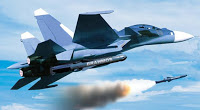
India test-fires manoeuvrable version of BrahMos

 
India today successfully test-fired a highly manoeuvrable version of the 290-km range supersonic cruise missile BrahMos from a naval warship off the coast of Vishakhapatnam in Bay of Bengal.
“At 9.30 a.m., the missile blasted off in a pre-designated war scenario taking a ‘double-manoeuvre in S-form’ hitting the designated target ship just one metre above water line. The sheer velocity and power of hit made the missile rip through the ship’s hull,” BrahMos Aerospace CEO A. Sivathanu Pillai said here.
This is the 34th launch of BrahMos after the successful October launch from INS Teg in the Arabian Sea.
The BrahMos missile system was inducted into the Indian Navy in 2005 when it began arming the Rajput-class guided missile destroyers and inducted subsequently in many warships.
BrahMos is capable of acquiring data not only from the American GPS but also from Russian GLONASS satellite systems also, which ensures double redundancy.
In the last stage, the seeker takes over and the target is located with accuracy of few metres which ensures no chances of survival for the target.

“This has been proved once again today and with bulls eye accuracy,” officials said.
Defence Minister A.K. Antony congratulated the warship commander and Indian Navy and BrahMos team for the demonstration of capabilities, they said.

Sunday, 23 December 2012

India Successfully Test Fired Air to Air Interceptor Astra Missile

India on 21 December 2012 test launched its indigenously developed beyond visual range (BVR) air-to-air interceptor missile Astra at the interim test range (ITR) at Chandipur in Odisha.

The missile was fired from the launch pad number two of the Defence Research and Development Organisation (DRDO) run missile testing centre at around 13.30 hours to confirm its reconfigured propulsion, control and guidance systems.

The launch was carried out against an electronic target and it destroyed its target - a small pilotless Lakshya aircraft - which was launched from the same base just minutes before the firing of the missile.

The missile had already been test-fired from the Chandipur facility several times in the past. The test on 21 December 2012 was just development trial of the missile.

After completing all the developmental trials, Astra would be ultimately integrated with combat fighter aircraft Sukhoi-30, MIG-29 and the Light Combat Aircraft.
                      

Missile Specification:

• Astra has the capability to intercept and destroy enemy aircraft at a supersonic speed and can be fitted into any fighter aircraft.

• 3.8 metre long, it is considered as one of the best of its kind in the world as it weighs about 160 kg and can carry explosive loaded conventional warheads up to 15 kg.

• It is designed to intercept and destroy enemy aircraft at supersonic speeds (1.2 to 1.4 Mach) in head-on and tail-chase modes.

• The missile uses solid propellant and can carry a conventional warhead weighing 15 kg.

• It can be launched from different altitudes and cover 110 km when fired from an altitude of 15 km, reach 44 km when launched from an altitude of eight km, and 21 km when launched from the sea-level.

Thursday, 20 December 2012

Induction of Brahmos Air version, C-17 aircraft next year

Asian Defence NewsInduction of Brahmos Air version and C-17 Aircraft would form part of the major expansion in the Indian Air Force during next year, Chief of Air Staff, Air Chief Marshal N A K Browne said today

The first C-17 Globemaster Aircraft would reach India and the Air Force by June next and would be mainly utilised for strategic lifting and transport ofBSE -0.06 % goods and troops, besides humanitarian relief works, Browne told reporters at Sulur Aircraft Station.

The Government has ordered 10 such heavy lift military aircraft and would be based at Hindon, the entire lot was expected to reach by 2015, he said.

Browne, here to participate in the function where two of IAF flying squadrons were awarded the President's Standard by President Pranab Mukherjee, said the much awaited air version of Brahmos would be launched by December next year.

Since it has to go for fitness test on Sukoi-30, which was not even done by Russian Agency, it would take time for such trials and the version would be launched by one year. "This is the first of its kind in the World," Browne said.

Regarding Apache attack aircraft, Browne said he had already said the acquisition process of US-Made Apache 22 will continue to remain with IAF and Army has to go in for another proposal and wait for the Government's nod.

Since both Navy and Army have their own aviation segments in a smaller way, it was upto them to acquire, he said.

Moreover, IAF did not want duplication, since it has the full responsibility of aviation, he said adding that it was also planned to phase out Mig-21 and 27, and replace them by Sukoi-30 in a phased manner.

Stating that IAF would have 39 squadron by 14th five year plan, from the present 34, Browne said Light Combat Aircraft would also be inducted by 2015 in Sulur.


On shortage of manpower, he said the force was short of 700 pilots, which would be filled by 2017, as constraints for training was creating problems to increase the strength.

To a question on accidents, he said on an average there were 11 to 12 accidents in the last three years. However, during this year (April-December) only three were reported, indicating that the Force was taking adequate steps to ensure safe running of aircraft, with advanced technology.

On whether there was tension in the area bordering China, Browne said "we examine continuously everything happening on the border.There is no no cause for concern."

Tuesday, 11 December 2012

Statement On Apache For IAF In Indian Parliament, Future Attack Copters For Army

After formally announcing the CH-47F Chinook's victory in the Indian Air Force's heavy copter competition last week in Parliament, the Indian defence minister has now officially confirmed Boeing's AH-64D ApacheBlock III win as well. Here's the full statement in Parliament today:
Indian Air Force (IAF) is procuring Chinook Ch-47F heavy-lift helicopters and AH-64D Block-III Apache helicopters from Boeing Company of USA. In the two separate proposals initiated by Indian Air Force (IAF) for procurement of 15 Heavy Lift Helicopters and 22 Attack Helicopters, M/s Boeing of United States of America (USA) with Chinook CH-47F(I) and 'Apache' AH-64D respectively, has emerged as the L1 Vendor. The Acceptance of Necessity (AoN) cost for 15 Heavy Lift Helicopters and 22 Attack Helicopters is Rs.2468.41 Crores and Rs.3094.98 Crores respectively. However, final cost of the Contracts would depend upon outcome of the Contract negotiation with the L1 Vendor.

Importantly, the government also reiterated its recent decision on future attack copter purchases going straight to the Army:

Government has decided to let the Army to have its own heavy duty attack helicopter. The decision to vest the future inductions of attack helicopters with the Army has been taken keeping in view the operational requirements in the field.

The Minister also made the following statement in response to a question on media reports of faulty Chinese-built spares in US aircraft for India:

While Government is aware of certain media reports regarding possible usage of Chinese counterfeit electronic parts in military aircraft manufactured in the US, no P8I aircraft has so far been delivered to India. Moreover, during the last four years of operation of the US defence equipment including C-130J transport aircraft, IAF have not encountered any faulty spare parts and equipment. It has been confirmed from M/s. Boeing, the vendor of P-8I, that no counterfeit parts have been installed on the aircraft to be supplied to India. Besides this, the Indian Air Force (IAF) have acquired a list of supplier from the US Government with respect to aircraft procured from the USA and none of the suppliers are found to be Chinese manufacturers.

Friday, 7 December 2012

Nearly 700 scientists quit DRDO in six years: Govt

Nearly 700 scientists have resigned from India's premier military research body DRDO in little less than six years from 2007, Defence Minister A K Antony said

In a written reply to a question in the Rajya Sabha on resignation of scientists from Defence Research and Development Organisation(DRDO), Antony said a total of 637 scientists resigned during 2007-2011 and 50 scientists up to October 31 this year.

Scientists who had resigned have either cited personal or domestic reasoms for leaving DRDO, Antony said.

However, it is assumed that increased opportunities or incentives available in other organisations and industries is the main reason of such resignation, he added.

On incentives taken as corrective measures to restrict resignation of scientists from DRDO, Antony said excellent infrastructure facilities have been created at work places and residential complexes and two additional increments have been given on promotion to each grade.

To another question, Antony said DRDO is a subordinate organisation under Defence Ministry and does not enjoy any special powers or autonomy because of its strategic nature of work.

Asked whether DRDO enjoys a huge amount of autonomy because of its strategic nature of work, he said, "DRDO is a subordinate organisation under the Department of Defence( R&D) in Defence Ministry and is governed by central government rules and regulations.

"Therefore, DRDO as an organisation does not enjoy any special powers or autonomy because of its strategic nature of work."

Revised delegation of financial powers of Director General of DRDO was carried out in 2010 to address a long standing requirement and was done after due process and deliberation, he said.

"The process of exercise of these powers has been further rationalised and a corrigendum has been issued by Department of Defence (R&D) on November 21, 2012 as a partial modification to the earlier financial powers," the minister added.

Saturday, 1 December 2012

MI-26T2 and IL-78MK-90 will continue to fight for Indian order

Rosoboronexport expects to win the Indian Air Force tenders on the delivery of heavy-lift transport helicopters and refueller aircraft in which Russia is offering the Mi-26T2 helicopter and Il-78MK-90 aircraft respectively.

Rosoboronexport disproves media reports about Russia's losing the above mentioned tenders and informs that such publications are not true. The results have not been announced yet and any early announcements mislead general public and professional community both in Russia and India.


The Mi-26T2 heavy-lift transport helicopters and Il-78MK-90 tanker are worthy of winning both tenders not only because they are unique military air systems fully meeting specifications of the Indian side but also because they attract potential customers by cost-effectiveness.

The newest Mi-26T2 heavy-lift transport helicopter has the following obvious advantages:

Mi-26 type helicopters have been successfully operated for a long time in India which will not need to retrain pilots and technicians for them and has already the infrastructure required;

Mi-26T2s are the world’s biggest serially produced helicopters with 20-tonne lifting capacity comparable to that of the C-130 Hercules military transport aircraft: in one sortie the Mi-26T2 helicopter can transport 82 troops with their equipment, quickly transfer a wide range of heavy-weight combat vehicles suspended on the external cargo sling, and in general implement important transport missions by a small group of the helicopters;

in one flight the Mi-26 type helicopters can perform transport as well as assault, search-and-rescue and special-purpose tasks similar to successful operations it carried out in hot and high areas in Afghanistan and other regions, proving its vast combat experience gained in difficult conditions, and high flight safety standards;

Mi-26T2 is sturdy in operation thanks to the installation of protection devices which practically do not reduce service life of its engines and accessories when operating in sand formations; this Russian helicopter also has high field repairability characteristics which speak in its favour too;

information field in the Mi-26T2 pilot cabin is formed by multifunctional “glass cabin” type displays, and its engines are electronically controlled.

The newest Il-78MK-90 refueller aircraft has the following obvious advantages:

Il-78MK-90 has been developed basically as a military transport aircraft: it can be quickly converted into a full-size military transport aircraft for rapid shipment of cargos, heavy combat vehicles and troops, but the multifunctional design allows its deployment as firefighting, flying ambulance, air command post and airborne early warning aircraft;

Il-78MK-90 can operate from paved and unpaved runways which means that the Russian aircraft can use more than 80 percent of runways available in India, and thanks to this fact there will be no issues with the dispersion of air refuellers over the national airfield network in case of necessity;

Il-78MK-90 is equipped to provide air refueling of other aircraft with two types of fuel in one flight, and on-ground fuel dispensing at the rate of up to 1,500 l/min for field refueling of up to four aircraft, transportation means and armoured vehicles;

Il-78MK-90 is checked for the capability of carrying out refueling operations with all heavy-weight aircraft in the Indian Air Force inventory;

The Il-78MK-90 power plant includes four engines which provides high level of combat survivability in case that one engine is damaged;

Il-78MK-90 features the new PS-90A-76 low fuel consumption engines,  modified wing, reinforced landing gear, integrated avionics suite including the “glass cabin” with multifunctional liquid-crystal colour displays and “smart” control panels;

Il-78MK-90 can perform intercontinental commercial air shipment operations since it meets international ICAO noise and emissions standards.

Friday, 30 November 2012

India Air force Jaguar Crashes, Pilot Ejects

An IAF Jaguar strike aircraft crashed today in Sikkim in India's North-East, the third crash since April this year (the last was a MiG-21 in Western India last week). The Jaguar pilot Flt Lt Yogesh Kumar Yadav managed to eject and has only sustained minor injuries. A detachment of Jaguars is currently based at the IAF's base in Hashimara. A court of inquiry has been ordered into the crash.

Thursday, 29 November 2012

K-15 test off Andhra coast next month

After the successful trial of AD interceptor missile, DRDO is readying for the developmental trial of submarine- launched ballistic missile K-15 from an underwater platform off the Andhra Pradesh coast in the second week of December.

The much awaited test, scheduled for the last week of November, was postponed owing to inclement weather triggered by a deep depression in Bay of Bengal early this month. DRDO scientists are reportedly contemplating two trials of K-15, one from a pontoon (replica of a submarine) and another from a submarine.

Defence sources said the nuclear capable missile will be tested for the first time from a submarine positioned undersea off  Visakhapatnam coast. If everything goes as planned, the missile will be fired any time between December 6 and 8.

The DRDO is eyeing for the successful trial of the missile as few countries have the triad of firing nuclear-tipped missiles from air, land and undersea. The other countries, which have the capability include Russia, the USA, France, Britain  and China.

 “Scientists are working over time and constantly cross-checking the system, including the launch platform. We want to achieve near-zero circular error probability (CEP) accuracy,” said a defence scientist.

The indigenously developed K-15 missile is about 10 metres in length and about a metre in diameter. Its launch weight is about 10 tonnes. This missile uses solid propellant and can carry a conventional payload of about 500 kg to one tonne and also be fitted with tactical nuclear warhead. After its induction, the missile will equip the country’s first nuclear-powered submarine ANS Arihant.


Reports said the K-series missile programme formally began in 2004 as PJ-08 as a tribute to the then DRDO chief and former President APJ Abdul Kalam. The solid-fuel missile had a modest 150-km range but over the years, the missile steadily grew to achieve its desired 700-km range.

“The hybrid K-15 combines aspects of both cruise and ballistic missiles, which use multiple-stage rockets to exit the atmosphere and re-enter in a parabolic trajectory. It flies in hypersonic speed. Launched underwater, the K-15 surges to the surface and is the world’s best weapon in this class,” the scientist said.

The K-15 is one of the most ambitious projects of the DRDO. After its successful induction, the DRDO would go for the developmental trials of its longer-range K-4 missile to strengthen its undersea attacks. Apart from the K-15, India has the submarine version of BrahMos supersonic cruise missile in its arsenal.

India, Israel Defence Secretary-level talks from December 3

India and Israel are expected to discuss the progress in their joint military projects including air defence systems and specialised radars during Defence Secretary-level talks starting on December 3 here.
Israeli Defence Ministry's Director General Maj Gen Ehud Shani will be in India to take part in the meeting of Indo- Israel Joint Working Group on defence cooperation with Defence Secretary Shashikant Sharma, ministry officials said here.
The two countries, who have developed very close military ties in the last 10-15 years, hold this meeting annually and discuss the ongoing and future military cooperation projects.
The two countries are working on several important projects including the Rs 10,000 crore Long Range Surface to Air Missile programme for the Navy and the Medium Range Surface to Air Missile project for the Army.

India is also progressing the case for buying two more Airborne Early Warning and Control System (AWACS) as the follow-on order for the three already inducted by the IAF.
In recent years, the DRDO has also been working very closely with Israeli firms for joint development projects including sophisticated radars and surveillance systems.

Sunday, 25 November 2012

Indian Defence Ministry Denies Allegation Of Non-Payment Of Pensionary Benefits To 26/11 NSG Commando

In a press conference today, retired Nk Surender Singh of 2 GRENADIERS and an ex NSG Commando expressed some grievances against the government. These pertained to alleged lack of adequate compensation and financial benefits to those who were killed/injured in the 26/11, Operation Black Tornado in Mumbai. Response with respect to the issues raised is enumerated in succeeding paragraphs.
           
In the 26/11 Mumbai operations, one Officer and one Non Commissioned Officer were martyred and 17 Officers and Other Ranks were injured. Both martyrs Major Sandeep Unnikrishnan and Havildar Gajender Singh were awarded the Ashok Chakra (Posthumous). The NOK of Major Unnikrishnan got a financial compensation of approximately Rs.1.3 Crores and a flat. Similarly, the wife of Havildar Gajender Singh received approximately Rs.1.27 Crore, a petrol pump and a flat. His mother too received Rs.15 Lakhs approximately. Both these personnel also received enhanced pension benefits as applicable in the Army.
           
As regards the injured, there were one Kirti Chakra, two Shourya Chakra, six Sena Medals, one Mention in Despatch and three Chief of the Army Staff Commendation Cards awarded. Four persons with grievous injuries received financial compensation of Rs.4.8 lakh each and others with lesser injuries received Rs.2.3 lakh each.

           
NSG is a deputation organization where personnel from the Army serve for three years and those from the CAPF, for 5 years.  Nk Surender Singh came to the NSG on 9 May 2007. He suffered Acoustic Trauma during the Mumbai operations and became a permanent Low Medical Category on account of Sensory Neural Deafness of the Left Ear. In the normal Course, he would have been reverted to his parent unit 2 GRENADIERS on completion of his three year tenure on 8 May 2010. However, on compassionate grounds, he was retained in the NSG till 15 October 2011, when he was boarded out by a Medical Board at Army Base Hospital Delhi under the aegis of HQ Delhi Area.

Nk Surender Singh has been sanctioned pensionary and terminal benefits viz-a-viz retirement gratuity Rs.2,11,458/-, Commutation of pension Rs.11,35,809/-, Armed Forces PF Rs.6,48,195/-, Army Group Insurance Rs.1,13,849/- and Army Group Disability Cover Rs.10 lakhs, Final settlement of accounts Rs.89,705/- and ex-gratia from welfare fund Rs.10,000/-.  He is also entitled to an ex-gratia compensation of Rs.9 lakhs for 100% disability which will be processed separately.   He has been sanctioned a pension of Rs.25,254/- per month which includes service elements and war injury elements.
 His Ex Servicemen Health Scheme Card has also been dispatched to the Zila Sainik Board, Jhajjar District on 05 October 2012 for handing over to the individual.
           
As regards, financial donations received from various private entities, in accordance with the Service Rules, only contributions to the NSG Central Welfare Fund were accepted.  For financial contributions on individual names, only amounts received for the NOK of the deceased were accepted and paid to the NOK.  Other contributions were returned to the donors in accordance with rules with the proviso that the same be remitted to the NSG Central Welfare Fund.  Therefore, the Cheque of Rs.7 lakh received from Mr. MS Dhoni was for the NSG Central Welfare Fund and was credited accordingly.
           
The Government has taken all care to pay all entitled terminal benefits due to Nk Surender Singh.  In case, he still has any grievance, the Ministry of Defence is prepared to look into it.

India eyes on Israel's Iron Dome to counter Pakistan

As Fajr V rockets rained down on Israel from battleground Gaza for a week, many Indian defense planners were keeping a close watch on the performance of Israel's Iron Dome, which is probably the only deterrent to these homegrown short-range missiles.
It was not just out of curiosity regarding one of the most effective systems against rockets, but also because of the possibility of India acquiring an indigenous version of Iron Dome.
Several months ago, the military scientists in the Defence Research and Development Organisation (DRDO) had suggested that India look at a joint development programme with Israeli firms to develop an Indian version of Iron Dome, which is touted as the most effective system against short-range missiles such as Fajr V rockets. The Indian scientists believe Israel's plight has several parallels to its threat from Pakistan as well as the vulnerability of its cities from terrorists.
The Iron Dome, according to reports, intercepted 87% of the rockets fired at Israel by the Hamas. The system, produced by Israel's Rafael Advanced Defense Systems and at work since 2011, is believed to have the capability to shoot down rockets and artillery shells with ranges of up to 70 km. The system has been shown to be effective against rockets or shells that might target populated areas.
In the Indian military establishment, the temptation for acquiring this new toy is explained by the fact that India is ringed by hostile neighbours. Pakistani terror groups like Lashkar-e-Taiba (LeT) could well acquire similar capability that would threaten large groups of Indian population. Even otherwise, the strategic planners have for long been worried about the deadly effect of short-range rockets fired at Indian cities or from across the border.

Unlike ballistic missiles, against which DRDO claims to have a fairly good anti-ballistic missile shield, there is almost no protection against short-range rockets or artillery fire. DRDO is currently collaborating with Israeli firms to develop medium range surface to air missiles (MRSAMs) and LRSAMs. However, Iron Dome is in a different class all together, Israeli diplomatic sources here argue.
One of the reasons why some Indian defence planners is pushing for it is the possibility of another conflict with Pakistan, where a system like the Iron Dome might be useful to deter even conventional artillery attacks. In addition, Pakistan has developed a tactical nuclear weapon like the Nasr, which is a solid fuelled battlefield range ballistic missile. While Pakistani analysts say this was developed in anticipation of India's supposed Cold Start doctrine, some Indian sources say the Iron Dome might be an effective deterrent against this new weapon.
On the other hand, acquiring such defensive systems in anticipation of similar attacks might prove to be too much a temptation for groups like LeT. While they haven't yet developed rockets like the ones the Hamas has been using, the lure of such home-grown weaponry should not be under-estimated, say diplomatic sources.
According to sources, there have been some discussions between DRDO and their Israeli counterparts for a possible joint development of Iron Dome for India. "The Israeli team comes and works in our laboratories. Our team goes and works in their laboratories and industries. There is a learning that is taking place which was not there when we buy things and integrate with existing products... In directed energy weapons — we are focusing on fibre laser, high powered micro-waves, etc. We have also started discussions with Iron Dome for co-development (in India)," Dr W Selvamurthy, Chief Controller looking after international cooperation, told the Economic Times recently.
How it works:
* The system detects launches of rockets and quickly determines their flight path. If it is headed toward populated areas or sensitive targets, it fires an interceptor with a special warhead that strikes the incoming rocket within seconds. Rockets headed toward open areas area allowed to land.
* Currently, five Iron Dome batteries are deployed in Israel. Most are located in the south near Gaza. A fifth battery was deployed outside Tel Aviv on Saturday, two months ahead of schedule. Hours later, it shot down a rocket headed toward Tel Aviv.
*Missiles cost around $40,000 a piece. In 2010, the US provided $200 million to expand development. Additional funding is currently being considered, with $70 million already allocated for this fiscal year.
*The system is part of what Israel calls its "multilayer missile defense". It is meant to protect against the tens of thousands of short-range rockets possessed by militants in the Gaza Strip and Hezbollah guerrillas in Lebanon. Israel has also deployed its " Arrow" missile defense systems for long-range threats from Iran. The military says its new "David's Sling" system, being developed by Rafael to stop medium-range missiles, will be activated by 2014.

Saturday, 24 November 2012

India Tests Interceptor Missile

DRDO Statement: The Interceptor Missile AAD launched by the Scientists of DRDO from Wheeler's Island, Odisha successfully destroyed the incoming Ballistic Missile at an altitude of 15 Kms. The interception took place at 12.52hrs. The target missile, a modified version of Prithvi, mimicking the enemy's ballistic missile, was launched from Launch Complex III, Chandipur. Long Range Radar and MFC Radar located far away could detect the Missile from take-off and tracked it through its entire path. The total trajectory of the incoming Missile was continuously estimated by the guidance computer and subsequently the AAD Missile was launched at an appropriate time to counter and kill the ballistic missile.

The Ring Laser Gyro based Navigation System in Target, Fibre Optic Gyro based INS in Interceptor, Onboard computers, Guidance systems, Actuation Systems and the critical RF Seekers used for the terminal phase have performed excellently. The AAD Missile system initially guided by Inertial Navigation system was continuously getting update of the target position by the Radar through a data link.  The Radio Frequency (RF) seeker tracked the Missile & Onboard computer guided the Missile towards the Target Missile and hit the target. The Radio Proximity Fuse (RPF) exploded the warhead thereby destroying the target missile completely.


In this mission, a special feature of intercepting multiple target with multiple interceptor was demonstrated successfully. An electronic target with a range of 1500 Kms was launched and the Radars picked up the target missile, tracked the target missile subsequently & launched an electronic interceptor missile. This electronic interceptor missile destroyed the electronic target missile at an altitude of 120 Kms. All the four missiles were tracked by the Radars and all the guidance and launch computers operated in full operational mode for handling multiple targets with multiple interceptor.  All the four missiles were in the sky simultaneously and both the interceptions took place near simultaneously.  This has proved the capability of DRDO to handle multiple targets with multiple interceptors simultaneously. The complete Radar Systems, Communication Networks, Launch Computers, Target update Systems and state of the art Avionics have been completely proven in this Mission.

Saturday, 10 November 2012

India’s First Aerospace SEZ On the Move


In a strategic step towards meeting the diverse and sophisticated forging requirements of the Indian and foreign aerospace and defence entities, QuEST Global Manufacturing, an Indian aerospace  engineering and precision manufacturing  major, has  set up SQuAD Forging India Private limited in collaboration with Aubert Duval, SA, France and Setforge Societe Nouvelle S.A.S. This facility covering an area of 50,000-sq ft and  located within India’s first aerospace SEZ(Special Economic Zone) promoted by QuEST Global Manufacturing in 2009-- on the outskirts of Belgaum --will become operational in 2013.Incidentaly, QUeST Global  aerospace SEZ is considered a major aeronautical hub outside Bangalore, the traditional nerve centre of Indian aerospace activities. According to Aravind Melligeri, co founder and Chairman of QuEST Global, the setting up of this state of the art forgings facility is in keeping with  the vision of bringing to the Indian aerospace sector the “capabilities and expertise” that are either non existent or difficult to come by within the country. Melligeri is quick to point out that high quality forging is one of the key components of the modern aerospace industry.
Significantly, QUeST Global has  pulled off the distinction of becoming  the first Indian private sector player to manufacture components for direct delivery to Airbus Industries under a long term agreement. This is apart from the MOU that QuEST had earlier signed with the Belgian aerospace entity SABCA for manufacturing metallic parts and assembly work for the Airbus A-350 XWB flap track structure. QuEST Global SEZ  is also into the supply chain   eco-system of Boeing. Under a contract with Swedish defence and aerospace major Saab, QuEST Global, is producing machined and sheet metal parts of the cargo door of Boeing 787 Dreamliner aircraft.

   QuEST Global aerospace SEZ, spread over an area of 300 acres, also boasts of Aerospace Processing India(API), an independent company that QuEST Global has floated  in tie up with Magelan Aerospace. API is the only facility of its kind in the Indian private sector to have built up the capability to offer high quality surface treatment facility. API is patronised by many of  the privately  owned Indian  aerospace and defence outfits including the companies promoted by Tata Industries. API continues to not only expand the portfolio of surface treatment through the addition of new and innovative techniques but also give a “green touch” to the entire process of surface treatment. This scalable facility, which has been in operation  since January 2009.like other facilities within SEZ has been approved by OEMs and Tier-1 customers.
  The current strength of QuEST Global aerospace SEZ lies in  aero-structures and actuation systems. Of course, as noted by Melligeri, further into the future, his aerospace SEZ will look into engineering the entire integrated assemblies   for global aerospace OEMS. But then Melligeris makes it clear that as of no the focus of the aerospace SEZs would be on metallic components, thereby implying that composites are  not on its radar. But he was quick to add that if some entrepreneur wants to set up a composite facility catering to the needs aerospace sector within the SEZ, he will be welcomed and provided all the support.
  Melligeri states that the growth of the aerospace SEZ would be realized through the joint venture route rather than through the path of acquisition. But Melligeri  also made a point that he is not averse to the process of acquisition if some good opportunities come by.  In 2011,QuEST Global  acquired the engineering services division of GKN Aerospace and entered into a long term agreement with the company to provide the engineering skills and resources  to support GKN Aerospace’s long term growth strategy.  
  Melligeri is also quite bullish about the prospects of offset deals that his SEZ could reap in the wake of a series of multi billion dollar defence deals India has signed with global defence and aerospace outfits.  Melligeri revealed that a few offset contracts have been signed without  giving out details. In particular, Melligeri pins hope on the lucrative opportunities inherent in the US$12-billion dollar contract that India would finalize for the acquisition of 126 medium multi role combat aircraft(MMRCA).
Everything going as planned  , India will seal the contract for the acquisition of 126  Rafale combat aircraft, the MMRCA  contest winner, before March.2013.
In the ultimate analysis, Melligeri’s strategy is to place the aerospace SEZ as a one stop shop offering design to build services--right from the concept design to finished product—and provide a total ecosystem for the aerospace sector. According to Melligeri, the strategic advantage of having players across the  value chain in the same location would be the amount of the time saved in moving parts from one location to another as well as associated cost of logistics.
Radhakrishna Rao, 1921,5th Cross,2nd Phase JP Nagar Bangalore-560078

Radhakrishna Rao in Belgaum
 
Related Posts Plugin for WordPress, Blogger...