Pages

Showing posts with label Submarine. Show all posts

Friday, 26 October 2012

Russia and Italy revive their joint conventional submarine

Russia and Italy have renewed their joint project of a conventional submarine small, the S1000, a source of bilateral military cooperation committee.

"The committee met in Italy in early October and discussed the possibility of launching the project. In the working protocol, the parties have compiled some steps to promote the S1000 on the market in third countries, "the source said.

For example, to reduce the price of the final product, the parties agreed to modify the distribution of equipment designed by Italy (80%) and Russia (20%). Initially, the distribution was 50/50. A major source of economy is the abandonment of expensive weapons systems design Russian.

Initially, the S1000 should be equipped with wire-guided torpedoes Black Shark (Franco-Italian design) and the Russian Club cruise missile capable of hitting targets on land and at sea at considerable distances.

"The simplification of the project, leaving the missile Club allows the abandonment of all associated systems and certain communication systems. Transport costs and customs are also reduced, "the source said.


The joint development of S1000 was launched in 2004 by Fincantieri and Rubin design office.

The work was carried out under the technical supervision and funding of the Italian Navy. The specification of concept was completed in 2008, but the project was then suspended due to financial problems.

It seems that the submarine would S1000 built by Fincantieri. They are not intended to marine Italian or Russian, but will be available only to third countries. If a contract is signed, it will take 48 months to prepare the technical documentation and build the first submarine of the series.

The conventional submarine S1000 is intended to be used in tropical conditions, amidst islands, mainly in shallow waters. The concept is based on a high combat effectiveness, ease of implementation and low cost.

Main features
16 + 6 crew commandos
Length 56.2 m
Diameter of 5.5 m thick shell
Submerged displacement Approximately 1,100 t
Approximately 250 m maximum immersion
Speed ​​14 knots underwater

Wednesday, 24 October 2012

Controversial report recommends Federal Government lease nuclear subs to save $10b

AUSTRALIA could save $10 billion by leasing nuclear-powered Virginia Class submarines from the US, says a Centre for Independent Studies report.
Author Simon Cowan also claimed it could save up to $0.75 billion a year in operation and maintenance costs.
The Future Submarine Project Should Raise Periscope for Another Look report from one of the country's most influential think tanks, said arguments against buying nuclear-powered submarines didn't stand up to scrutiny.
And it found leasing the fast attack submarines could avert "a potentially disastrous capability gap developing" between when the six Collins Class are retired and the replacement diesel-powered submarines are designed.
The project is expected to cost $36 billion. The Government has previously ruled out the nuclear option.
Opposition leader Tony Abbott, who previously had a former Centre for Independent Studies research fellow as an adviser, deferred to Defence spokesman David Johnston for a response.
Senator Johnston showed no sign of backing its contents, saying: "The Coalition is not considering a nuclear-powered option" and "work on the project will centre around the South Australian shipyards".
The report went on to rebut claims that Australia could not buy nuclear-powered submarines because it does not have a supporting nuclear industry.
Using a leasing arrangement meant the US could service the subs and also get rid of spent nuclear fuel, it said.

Mr Cowan's report criticised the existing process to replace the ageing Collins Class submarines with 12 new craft, saying the Commonwealth Government's current path "was marred by indecision and waste, conflicts of interest and substandard procurement practices".
SA Treasurer Jack Snelling rejected the nuclear-powered sub plan, saying it would be a wasted opportunity for thousands of jobs.
Mr Snelling said the Commonwealth Government had committed to building the new diesel-powered submarines in Adelaide and "what the US wants from its Virginia Class is different".
"It would make our submarine capability entirely dependent on the US," he said.

Tuesday, 23 October 2012

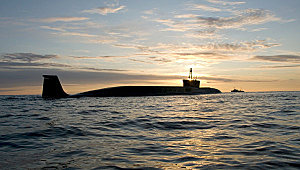
Delivery of a nuclear submarine in the Russian army postponed

The first nuclear submarine ballistic missile Project 955 Borei class, the Yury Dolgoruky, will be delivered to the Russian Navy in 2013 and not in 2012 as originally planned, said to reporters Monday the Russian Minister of Defense Anatoly Serdyukov .

"We expect that the first nuclear submarine Yury Dolgoruky Borei class is adopted by the army in 2013," said the minister after a meeting of the committee of the State Duma (lower house of parliament Russian) in charge of the defense.

Serdyukov was also hoped that the Alexander Nevski, the second submarine of Borei class, would be deployed in the Pacific in 2014.

Capable of firing ballistic missiles Bulava , submarines Borei class form the basis of strategic Russian Maritime Forces after the disposal of submarine classes Akoula (Typhoon according to NATO code) and Kalmar and Mourena (Delta and Delta-3-4 according to NATO) in 2018.


Sevmach the Russian shipyard in Severodvinsk (north) currently hosts three submarines of this class in various stages of construction (Yuri Dolgoruky, Alexander Nevsky and Vladimir Monomakh). The fourth submarine, named unofficially Sviatitel Nikolai (Saint Nicolas), will be the first ship new Borei class A, whose characteristics are superior to those of the Borei class. Total Sevmach plans to build eight submarines Borei and Borei class A.
Related Posts Plugin for WordPress, Blogger...